

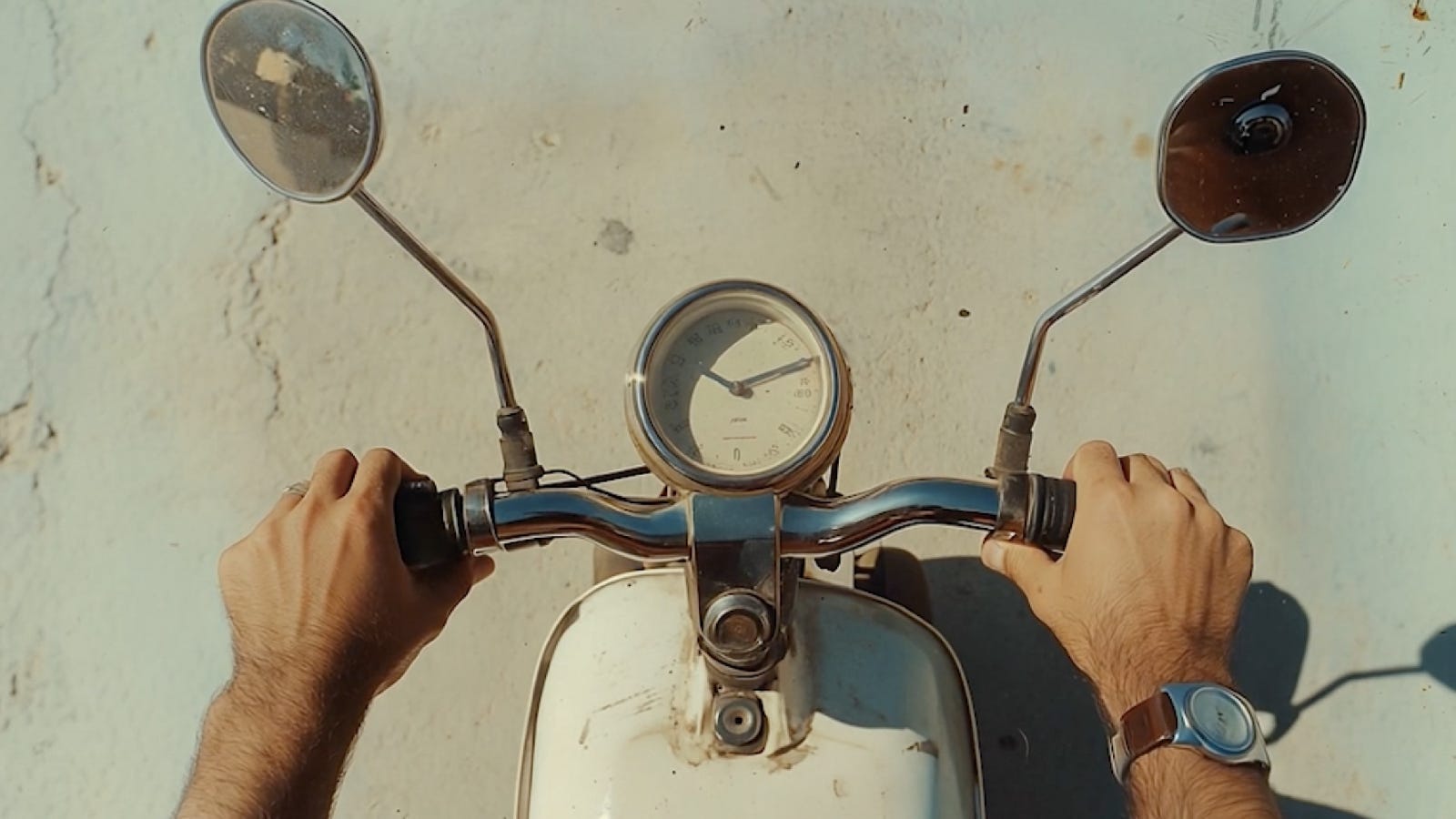
Image: Still from the movie Jamais Nansa Souvenirs
After returning to school as a mature student, I took Professor Tereza Barta’s Screenwriting for Production course at York University, where we watched many short films and wrote several of our own. The most common mistake we make, and other filmmakers do, is to make the story too big for the short movie. I wondered whether this applies to AI-made movies, and after watching some of them, I expanded my question to: how to watch narrative in the context of what’s possible with AI tools, and how narrative adapts to the tools.
It adapts, almost like the thing from The Thing. It was a revelation, a sort of understanding that the authors of AI movies are shaping their scripts around the possibilities and limits of AI tools, as they face challenges such as consistent character movement or complex interactions. That’s why we have many AI movies with narrators telling the story, while cinematic AI expression supports it. The one example of that style I loved is the movie Jamais Nansa Souvenirs (2 minutes and 14 seconds). It is rich yet minimalist in its narration, which drives the story and gradually pulls us into it. At the same time, it’s a love letter and a letter that asks, makes assumptions, and gives us a beautiful ending.
Simultaneously, shots that follow the story seem carefully planned to enrich what we hear; music gives another layer of authenticity. The choices the author made in the movie’s style, look, and feel are the right ones. But the most important one was voice - I saw it in a similarly styled movie; if the narrator’s voice feels off, everything is off. This was not the case in Jamais Nansa Souvenirs.
What I appreciate with this particular movie is that the author did not fall into the trap common with AI - do it because you can. Jamais Nansa Souvenirs is genuine.
What spoke to me personally is the movie’s immigrant theme and the question of identity. The author uncovers: I am doing this to get to know you and to meet myself. As traditional films do, this one is also a way for the author to tell their story and find deeply personal answers.
It is not perfectly executed, as some shots exhibit visible AI details, but this does not affect the story or diminish it.
As in traditional movies, AI filmmakers adapt to what they work with, as has been the case since the dawn of cinema. The other movie I watched, which also “adapted” to AI tools, is Mother. It’s horror, though categorized as drama, with a very nice 50s suburban vibe and almost no dialogue. Which does work great, although the story is not that strong. However, on this one, I found the dialogue part interesting, as it cleverly bypasses the tools’ restrictions and emphasizes tension and style.
In my other class, Screenwriting Fundamentals, with professor Ingrid Veninger, our first assignment was to write a screenplay with no dialogue. Which was hard for me, as I love to expose things through dialogue (Star Trek does that too!), but it was a great lesson in writing, and now a great tool for AI filmmakers.
Both movies are showcases - at least in my opinion - on how AI filmmakers adapt to the tools they have.
Let me know your thoughts, and feel free to share AI movies where the story works amazingly well.