

Cinema Shift festival 2026 (Photo by Kirsten Sonntag)
We landed at Pearson Airport in Toronto with six huge suitcases and two small kids in the summer of 2022. We had visited the city before and knew, in a sense, what to expect - but realistically, what was in front of us was a mystery. Just as Cinema Shift was. In the early days, it often reminded me of the TV show 1883 I watched, in which the characters ventured bravely into the great unknown (ours was less dangerous). We did wonder about our unknown - who is making AI-assisted films, what themes are they exploring, why are they telling their stories? YouTube and AI-assisted films there gave one answer to those questions. Still, for the Cinema Shift Festival, we needed the submissions to find our own answers: which genres would emerge, what themes filmmakers were exploring, and why they were choosing to tell those stories. I was especially interested in films made by first-time filmmakers - people who had never made a film before. After we closed submissions, we had enough to find some answers.
It’s a snapshot
This is not, by any means, a representative sample but a snapshot of one emerging filmmaking community at one festival in early 2026. Data was collected from FilmFreeway submissions, information we had about guests who attended the festival, the Audience registration survey and the Post-festival survey. Still, I found it quite interesting because it uncovered truths and details we did not expect. I loved exploring the theory that AI-assisted filmmaking could help the science fiction genre experience a rebirth, and I was very curious to see whether submissions reflected that.
We analyzed the data as we had it and published some of it on our social media channels.
The First Surprise
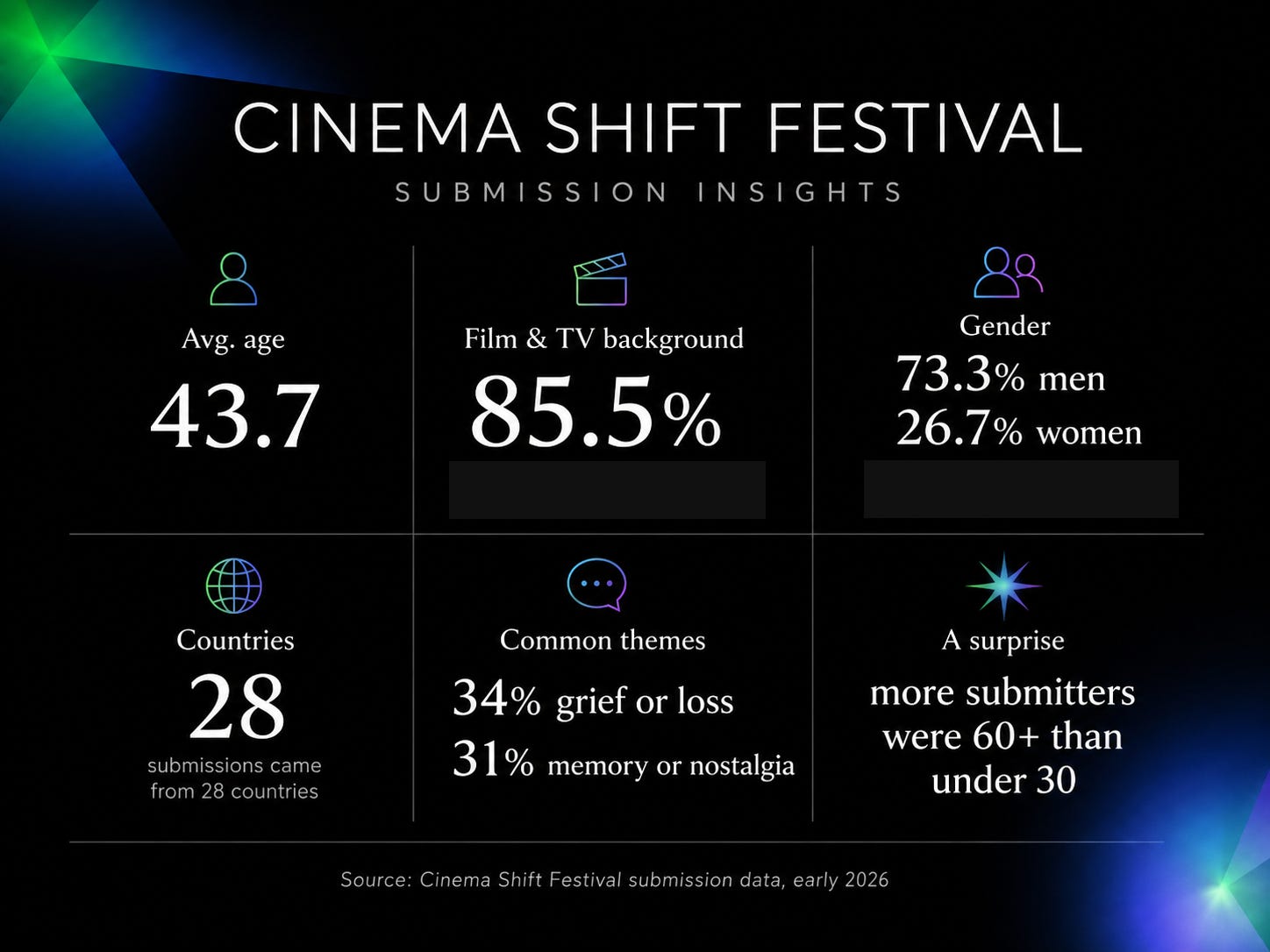
The average age of our submitters was 43.7. We really did not expect that. Another surprise was that 85.5% of submitters who provided a professional biography had a background in film or television. I assumed that their motivation was to test new tools, but we were in for another surprise.
34% of films had grief or loss as a theme, while 31% had memory and nostalgia - 6% were about grandparents. Why was this such a surprise? I expected more spectacle. This is purely anecdotal, but when you do your AI-assisted movie, you are swamped with possibilities. And definitely not thinking “less is more.” At least that was my case when I started playing with different tools. Hello, generation ship! Giant alien bugs and space wars!
While those things can be fun, without story and characters we care for, they are not much.
One of the grief movies that I could not get out of my head was Memento Mori. I felt such a deep connection to the story, and it felt relatable in a way I couldn’t explain. What I know is that this is a story about a man who reflects on the loss of his little sister. Grandmère is a film about grandparents, and one I loved dearly not only because of my grandparents but also because of my kids’ grandparents.
AI itself was much less present than I expected. Only two film titles explicitly used the term AI, and only 23.3% of the synopses mentioned AI or artificial intelligence. The words human or humanity appeared in slightly more synopses than AI did.
Interestingly, the youngest submitter was 24 and the oldest 64, and there were more submitters aged 60 or older than those under 30. Many also came from design, visual arts, VFX, animation, advertising, marketing, and other creative fields. Music, audio, education, and academia also appeared. This does not prove that AI filmmaking is being driven mainly by established professionals; Cinema Shift is a film festival, and FilmFreeway naturally attracts people already connected to filmmaking. But it does complicate the idea that generative AI is suddenly allowing complete outsiders to become filmmakers. At least in our first group of submissions, most were not starting from zero.
We had a gender gap: among submitters who provided information, 73.3% were male, and 26.7% were female. And as I was actively monitoring submissions, I also reached out to female filmmakers to encourage them to submit; if I hadn’t, there would have been even fewer. Why was this the case if AI filmmaking tools lower barriers?
The submissions came from 28 countries, most of them from the United States of America, and Canada was in second place. While Cinema Shift received entries from filmmakers worldwide, the distribution was uneven. Most of our submissions still came from North America and Europe, which made us wonder about who has access to new technologies. While our dataset was not sufficient to show that, I really hope the 2nd Cinema Shift Festival (2027) will see more submissions from other parts of the world, as well as from underrepresented communities. I do see AI film tools as tools that lower barriers and open doors.
Language showed a different pattern. Of the films that listed a language, 82.9% used English, even though submissions came from many countries. At least ten languages were represented in the collection, including Korean, French, Arabic, Spanish, Japanese, Swedish, Portuguese, Mandarin Chinese, and Finnish. So, while the first wave of submissions was international in origin, it was much more centred on English. AI may make it easier to produce films anywhere, but filmmakers still seem to choose English to reach international audiences. The reason for that could also lie in AI voices, which were much better in English at the time, but we have no evidence for that beyond personal experience with AI-assisted movies and voices.
We found another interesting thing in the submission data. In at least 32 submissions, the same person was listed as director, writer, and producer; in at least 52, the same person was both director and writer. This is not uncommon even for traditional movies, but the fact is that AI tools are compressing roles. Many filmmakers - as was my case - now direct, produce, generate images, edit video and sound, and, in the end, make their film alone.
Tools
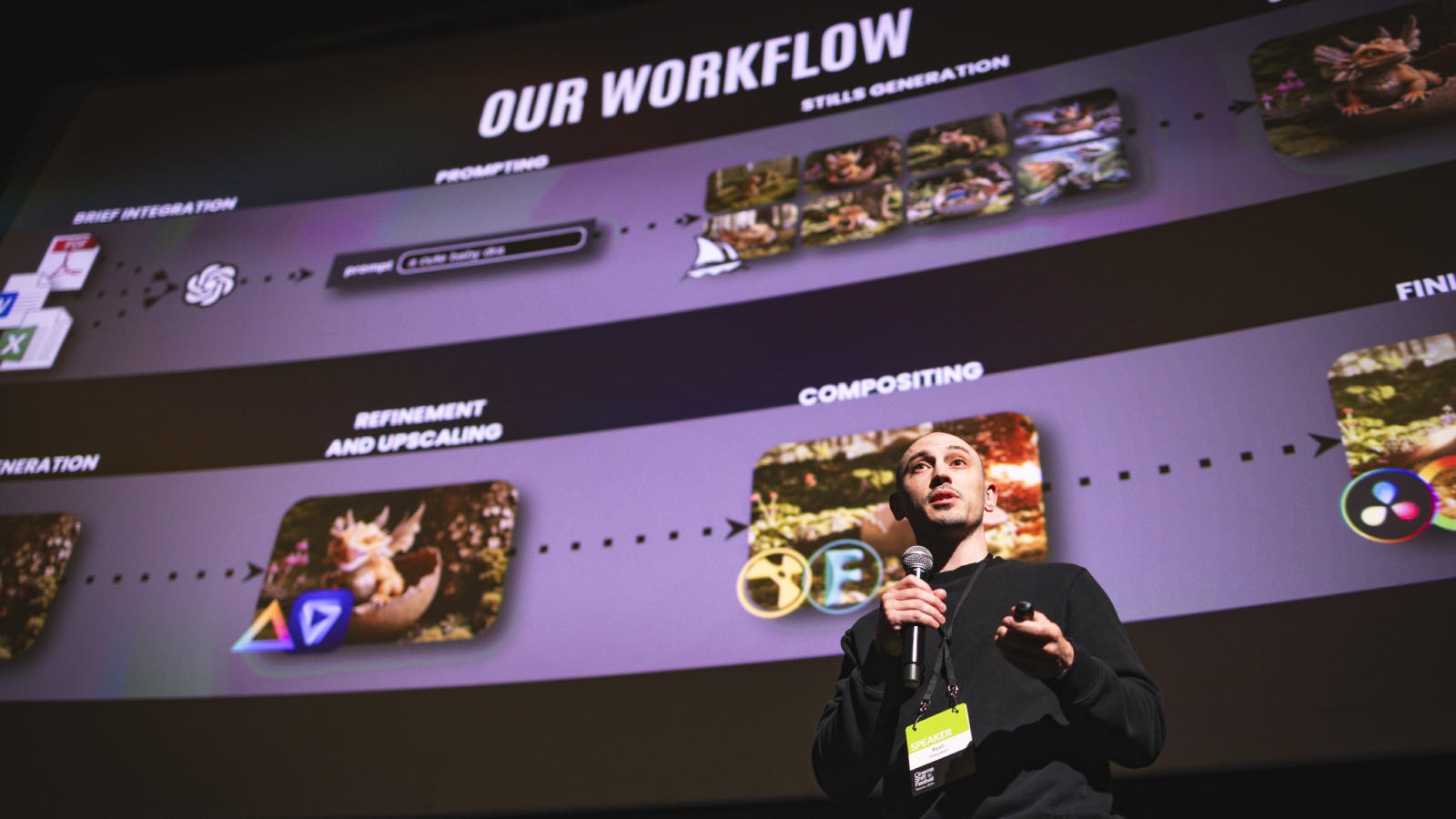
Ryan Stasyshyn, Rodeo FX, Cinema Shift Festival 2026 (Photo by Kirsten Sonntag)
Although this article is not about the tools, it was interesting to see which ones filmmakers actually used to make AI-assisted films. Just 20 films have revealed that information, and among those they were 27 different tools. Most often, filmmakers used Kling and ElevenLabs. Other than those two, they used Nano Banana, Veo, Suno, Midjourney, and Runway. Some filmmakers used just a few tools, while others listed as many as nine. What might look like one new production style from the outside is actually a mix of very different workflows created by each filmmaker.
The percentage of AI-generated material didn’t tell us much by itself. For example, Grandmère had about one minute of real Super 8 footage, and the director said 85% was AI-generated. Hazama also had roughly 85% AI-altered footage, but used a different hybrid process that combined live action with AI-assisted VFX. In another film, the filmmaker estimated that nearly 95% was made with generative AI, but made it clear that AI didn’t replace authorship. Instead, they called it a “medium of probability.”
We had other very interesting examples that showed us how exactly processes looked.
One three-minute, one-person AI film took over 200 hours to finish-more than 66 hours for each minute of the final product. Another filmmaker took a different approach. She first tried the project two years earlier but stopped because the technology couldn’t keep characters consistent. When she came back to it, she used several AI tools but decided against using an AI-generated voice because it lacked the emotion she wanted. She also replaced AI sound effects with work from a sound designer, including real footsteps recorded in real snow. In this way, authorship showed up not just in what the filmmaker created with AI, but also in what she chose not to use AI for.
The Audience
The audience data was just as interesting. Of the 248 people who answered the professional identity question, 37.5% described themselves as filmmakers, directors, or producers. Another 30 identified as AI or creative technologists, and eight worked in VFX or post-production. Together, that meant 52.8% of the audience came directly from film, AI creative technology, or post. If we add researchers and academics, the number rises to 63.3%. Cinema Shift was attracting people who were already working around the changes we were discussing, not just a general audience curious about AI.
That was confirmed by what people said they wanted to see. Talks and discussions were selected by 61.9% of respondents, compared with 54% for the film showcase. For a film festival, it was striking that conversations were selected more often than the films. It reinforced something we already felt while building Cinema Shift: people did not only want to watch AI-assisted films. They wanted to understand what was happening around them.
After the festival, we asked whether the experience had helped people think differently about AI, film, or creative technology. The response sample was small. 82.4% answered either “Yes, definitely” or “Yes, somewhat,” while nobody selected “No.” It was not proof that one afternoon at Cinema Shift changed anyone’s views, but it suggested that the screenings and conversations had done more than simply show people what the technology could produce.
The most beautiful surprise for me came from the themes, which showed how AI-assisted stories were personal and therapeutic; they came from the same place as in traditional filmmaking. The AI-assisted film I was working on at the time, Crush, came from the same place. The first Cinema Shift Festival did not answer all the questions, but it gave important clues and coordinates for the map of the first wave of AI-assisted films and filmmakers.
This essay is part of my ongoing Cinema Shift notes on AI-assisted filmmaking, authorship, and the first wave of AI cinema.