

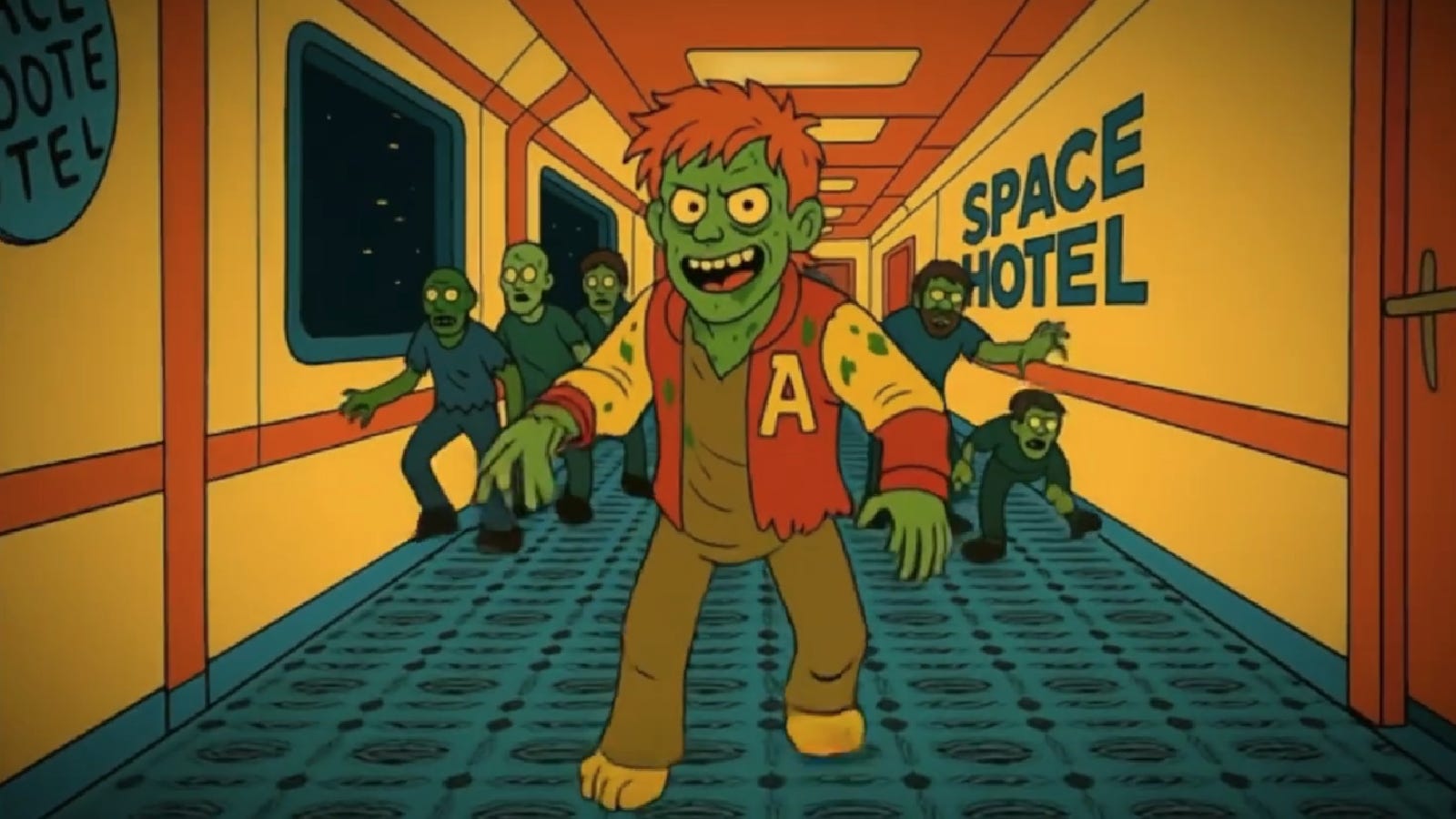
Image: From the AI-made animated series Zombie Monsters On Space Vacation
The things I learned about my script while making my own AI movie were unexpected. In 2025, I made my own animated horror-comedy YouTube show, Zombie Monsters On Space Vacation.
When a zombie outbreak breaks out in the first space hotel, James will do anything to stop the embarrassing video starring him from appearing on hotel TVs. What is the video? Weird handshake with President Reagan - James thinks Reagan is going for a bro shake, and he is not, so their fingers got intertwined, and everything is uncomfortable and shown on Live TV. Yes, that is my common fear - what would a shake look like, as today we have too many, let’s just stick to the traditional one!
In exploring cringe 80s space weirdness, my goal was to learn the tools and go fast - it was a low-budget time-constrained project. I used AI and traditional tools, simplifying things as much as I could. While I did learn AI tools like Runway and ElevenLabs, I spent a lot of time editing - hours of “lip sync”, matching voices, sounds - and I was especially happy when I was working on sound design that fit the story. There is something zenish in searching for the perfect zombie ROAR. All the voices are from ElevenLabs, and Runway was like a playground, allowing me to ‘build’ zombie attacks and conversations about Princess Leia, who “disrupts the narrative of passive femininity by killing Jabba the Hutt.”
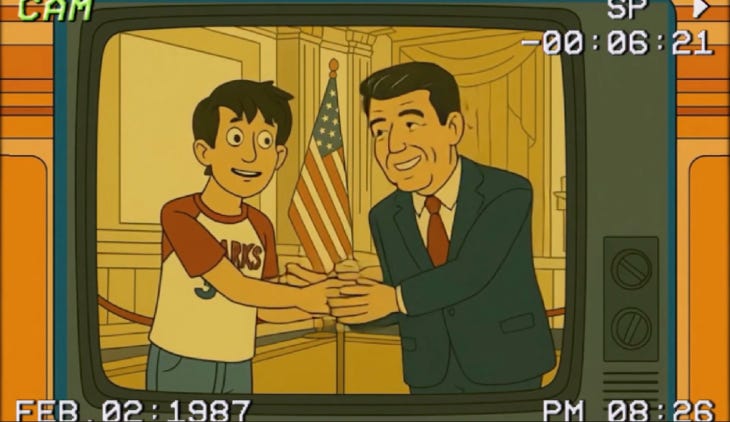
Image: An in-show TV broadcast from Zombie Monsters On Space Vacation.
Script vs Screen
I wrote the script in the summer of 2023, having fun with people stranded in the first space hotel, which is my favourite topic. My book Snow Outbreak, which I wrote in 2017, explores the same theme as my most recent SF TV drama, The Stellark. However, in Zombies, I added comedy, 80s, and horror inspired by parody movies from the same decade (Airport, Naked Gun, and Mel Brooks movies). In the script, my homage to the genre and decade is evident in many scenes, like when the Zombies walk in with “Thriller”-style choreography, which wasn’t possible in an AI movie; many other physical comedy scenes weren’t either, as AI just couldn’t do them in my timeline.
After I finished my 4-episode show, I realized how powerful AI could be for screenwriting students. Let them make one short movie just to see how the script transfers to the screen. And I don’t mean let somebody direct the script - let them do it. Their understanding of the script will be much clearer, I believe. That was one of my learnings. I cut a lot of it from the script because I realized it does not work for the story - it’s not moving it forward or telling us anything new about the world or characters. On paper, it looked like it needed to be there 100 %. In the end, I realized in production that some jokes didn’t work, and some scenes were unnecessary. It’s hard to see that, especially if you work on a screenplay for a year or two - I am too invested to see it clearly.
Adapt the script for AI
I wrote the script for traditional filmmaking, and since I’d never worked on an AI movie before, I worked on it as-is. However, the script should have been adapted to the tools’ capabilities. If you are writing for AI filmmaking, it’s better if you know what’s possible and what’s not. AI was not ready for my dining room scene: dialogue, TV footage, glitches, zombies, slapstick, chairs breaking, plates flying!
Also, I am not a director, but by watching and doing Zombies, I learned a lot about the choices you, as a director, make. Each one matters. My first episode was too fast and unclear, so I added title cards with brief explanations of the location and who/what.
The other thing I realized (again) is how pre-production is crucial - the better you prepare on paper, the easier it will be while making a movie. That is true on traditional sets and AI filmmaking. And still you will need to adapt on the way. Today, I will use detailed storyboards and a clear plan for every scene.
I also did not have some scenes because of the technology - they were not possible within the time frame I had. It was not so much about getting the scene as getting the scene right. Next time, I will definitely work from different perspectives - not only to write a script by having AI tools in mind (if I am writing for an AI movie), but also by thinking about the choices the director could make. I know, and they taught us - don’t think about the budget while writing. But, with AI, I think it is necessary to think about what’s possible and what’s not.
My original story, Snow Outbreak, became a zombie horror comedy script in 2023, a web series in 2025, and evolved into The Stellark, an SF drama, and all of that because I am obsessed with this stranded in space hotel story - it’s fun.