

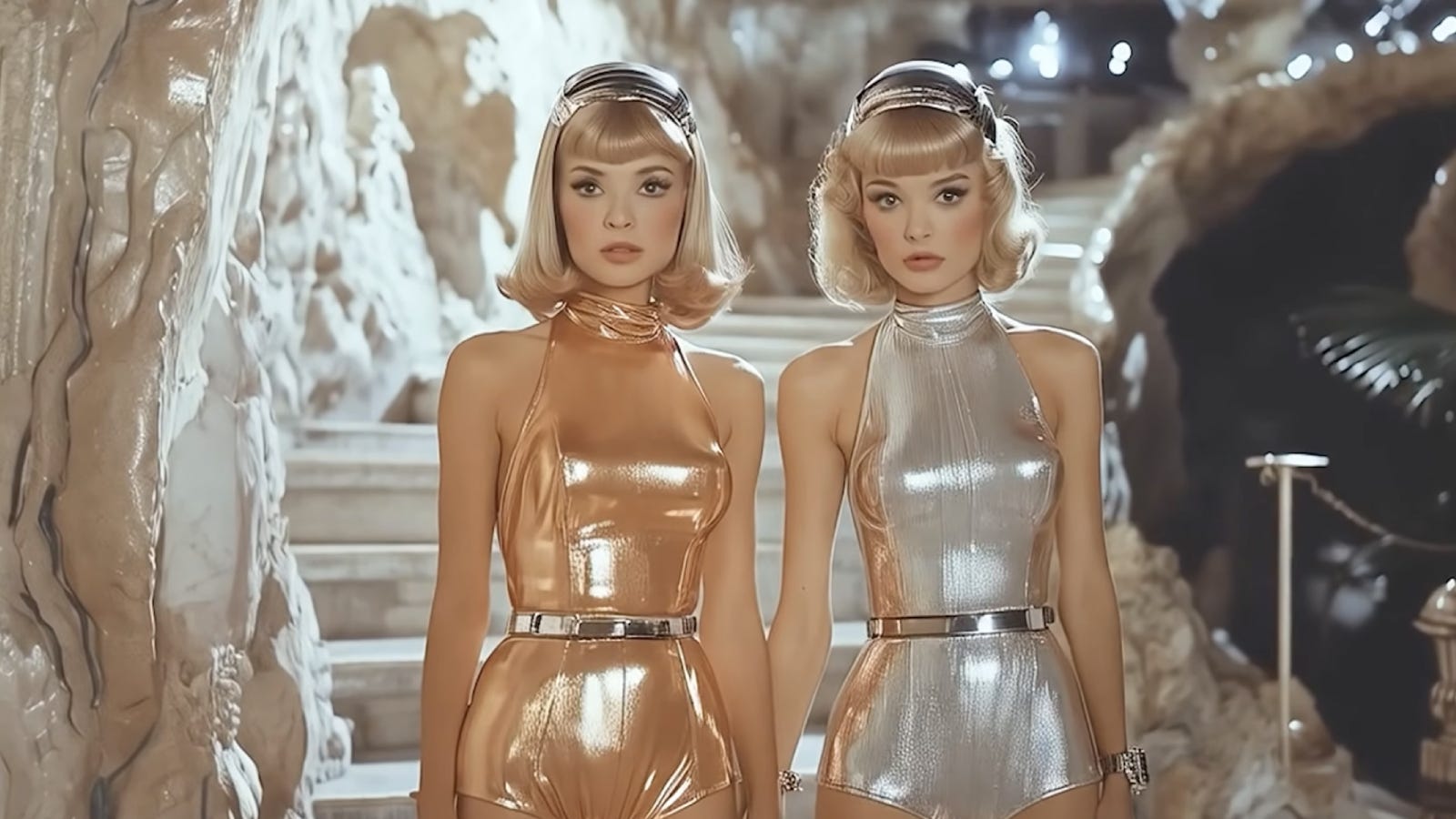
Image: From retro-future video
Why do fake nostalgia videos make us feel longing? That is at least how I feel when watching my favourite one, Abandoned Films (update July 2026: unfortunately, most of the content is removed). It is a channel that reimagines new movies, placing their trailers in other decades and styles, such as the 1950s Super Panavision style or the 1980s LaserDisc style. Another name for this phenomenon is anemoia, nostalgia for a time you never experienced, as explained in The Dictionary of Obscure Sorrows. If you want to dig deeper, read more about restorative nostalgia as defined in The Future of Nostalgia, a book from 2001 by Svetlana Boym - it’s nostalgia that patches memory gaps; one that attempts to rebuild a lost home or recreate an idealized, mythical past.
Space‑Age retro futurism
With Abandoned Films, the context is different, as they reimagine movies or TV shows we know and set them in a different timeline. Something similar, also within the new AI world, is retro-future videos. What they show is an imagined future, but from a past perspective. The channel I often have in the background while I work is AI Fascinated. It has playlists that take you both through sound and images in retro-futuristic universes; occasionally, the audio is human-made. However, channels that do retro futurism occasionally slide into restorative nostalgia, prioritizing immediately recognizable, highly optimized imagery. Almost always, the thumbnail features a beautiful, sexy AI woman, and often, women play a passive role. At the end, they do encourage the “Pin-Up” archetype: most videos feature women who aren’t just characters; they are stylized according to 1950s/60s male fantasies with tight “space-age” outfits, and hyper-perfected features. If it were trained on pulp magazine covers, we know where it comes from. And it does have a name - Algorithmic Gaze. It is for a broader discussion, and I am sure someone will analyze it more thoroughly.
Fan Fiction for Our Memories
Another trend in fake nostalgia is filling the gaps in our own “we want more” desires, as fan fiction movies do. Retro Star Music does precisely that by making a video that takes us with Bob Dylan to Newport 1965 (my favourite as I am just rewatching A Complete Unknown), or to Seattle and Nirvana in 1989, where you can almost smell cigarettes. But also to a 1968 Hollywood Hills and a night in Steve McQueen’s garage. Or even further away, in a whole other territory - with Madison Through Time, where we can watch “interviews” with people on the Titanic or in Skyrim. Boym calls this a double exposure, “A cinematic image of nostalgia is a double exposure, or a superimposition of two images of home and abroad, past and present, dream and everyday life.”
To circle back to my question about longing, it would be interesting to know how much influence humans had on the final product and on shaping the ambient and the mood. Because, in these particular AI videos, narrative lies in the worlds we watch and listen to. And possibly, humans choose one of 100 images that really make us feel, so there is definitely the art of selection.