

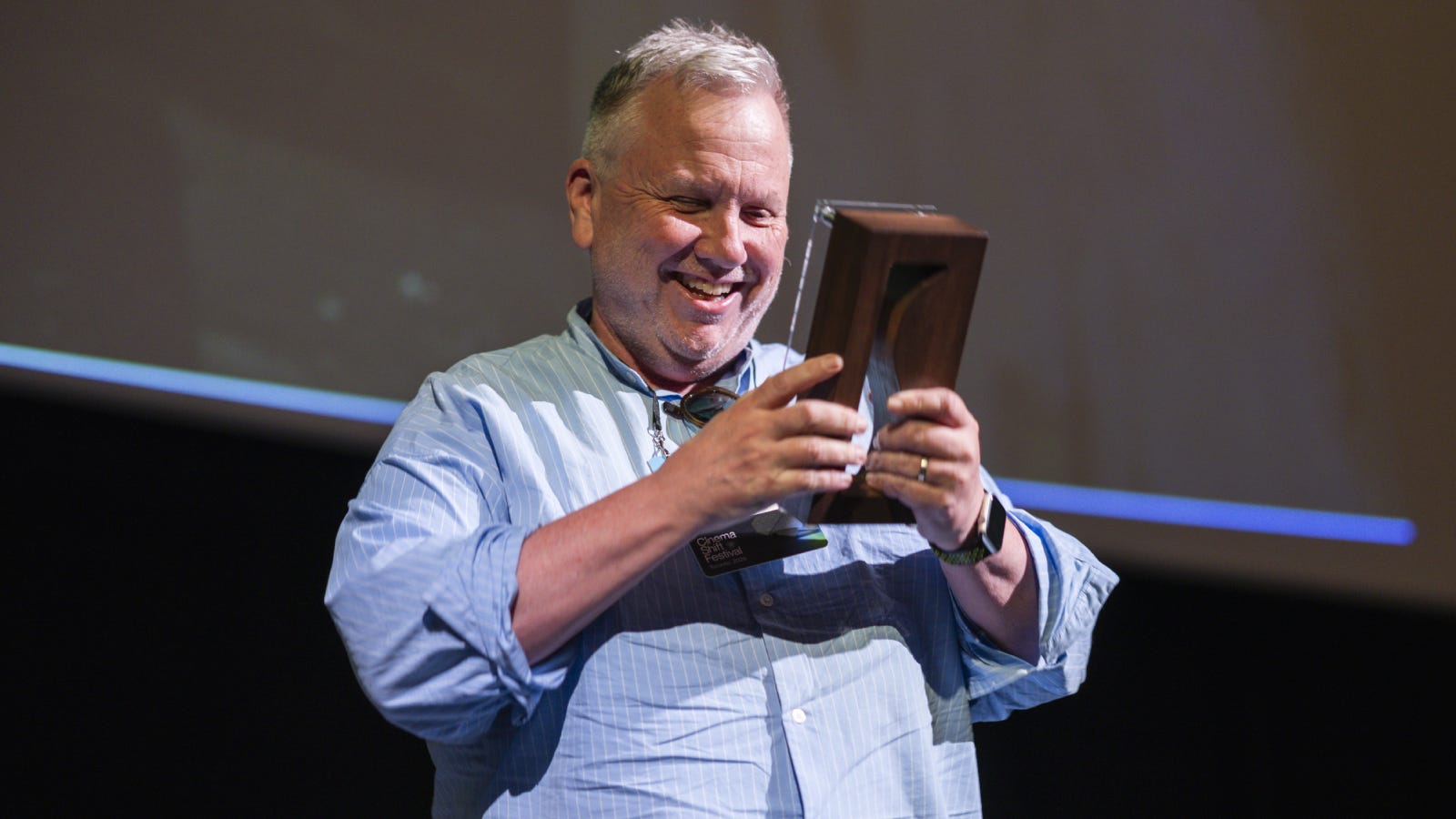
Gary Thomas, winner of Best Canadian AI Narrative Film, Cinema Shift Festival 2026 (Photo by Kirsten Sonntag)
Light snow is falling in Toronto; it’s February 11, and although it’s warm, around 0 C, it feels colder due to a chilly wind. My son and I are eating ramen at a place near Hot Docs theatre. I am showing him an email - we got our first submissions for the Cinema Shift Festival! He is as excited as I am.
It’s a story about a drone who discovers what it means to be unique, and the film is called When I Became Me. That same film would eventually win the Best Canadian AI Narrative Film Award at the Cinema Shift Festival. I did not know at that moment whether When I Became Me would be in the program - but I immediately understood the responsibility. And truth be told, it was scary and exciting at the same time.
The Context
Before we got our first submission, I knew that I wanted to look at the films through the broader context of the world we live in. I was hoping for more movies that would take a stand - for example, ones that would confront oppression, fascism, femicide, domestic violence, climate change, and human rights and have a strong opinion about it. If this sounds to you like a curator’s personal choice, it is - curating is deeply personal and subjective, and also an opportunity to showcase meaningful work that talks about important topics.
One of the films that did get into the program was The Stars by Afro Futcha, about the kid who collects stars - making wishes - which are actually bullets. Everybody understood the story; it felt a bit magical, and the child’s perspective made very personal connections with some jury members. Although jury members thought the cinematic quality was not exceptional, the story and emotional impact were so strong that the movie became a finalist in the Best AI Narrative Film category. I personally loved that it’s an anti-war story not only because I grew up during the war in Croatia, but because wars were raging at that moment. The world - reduced to information through scrolling - needed a reminder about the brutality of it.
The process
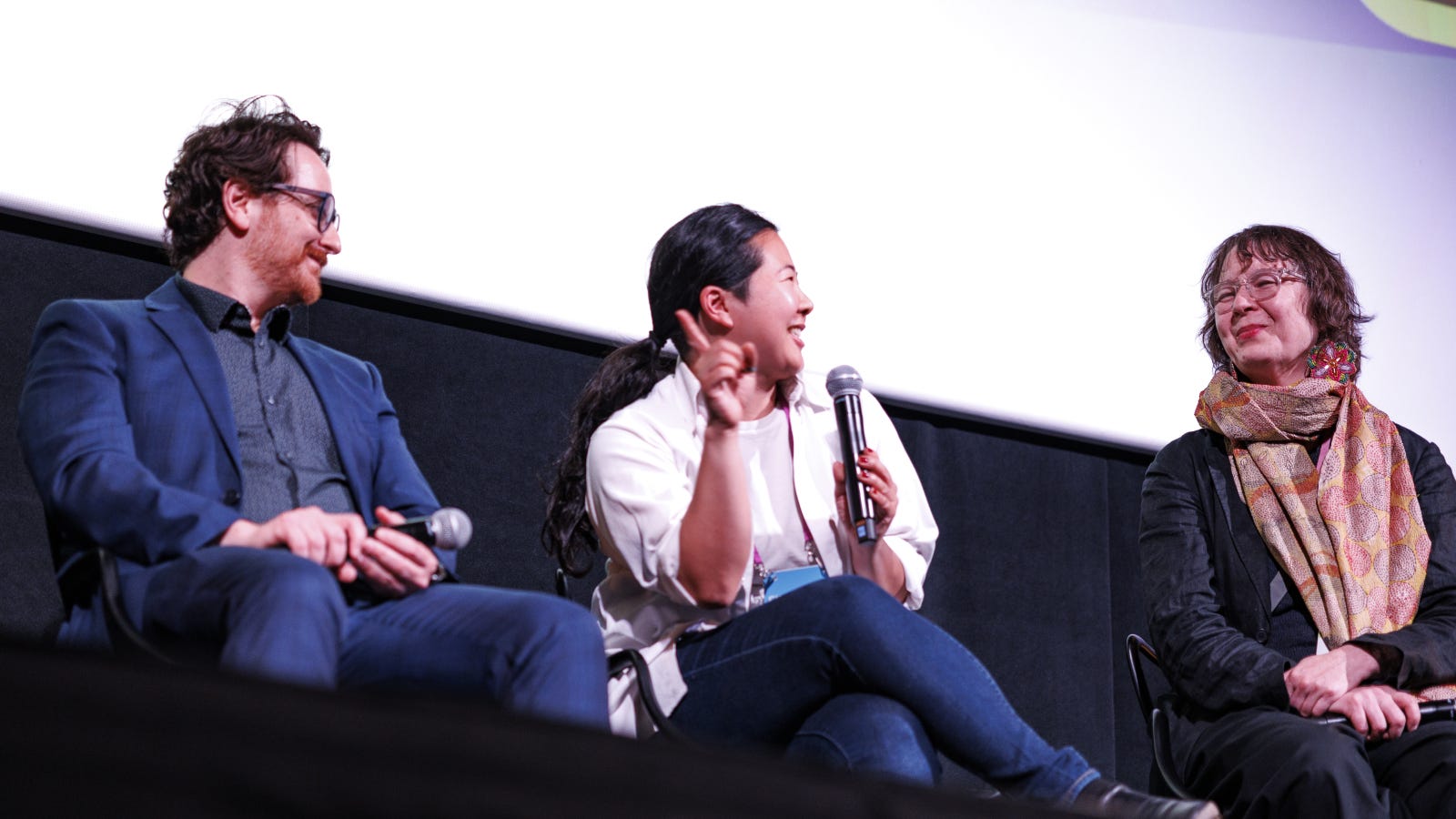
Jury members Fabio Montanari, Samantha Wan and Ann Marie Fleming (Photo by Kirsten Sonntag)
Before the jury members, I did the shortlist. I watched all the movies and graded them in four categories: Narrative Strength, Authorship & Intent, Emotional/Audience Impact, and Cinematic Quality. The first two categories were worth double because we prioritized story-driven work, human authorship, narrative intent and creative decision-making over tools or technical novelty. Narrative strength was important as it’s the core of every movie and, in most cases, why we love the films - a technically superior film was not worth much without an amazing story. In the Authorship & Intent category, we wanted to ensure that filmmakers make deliberate creative decisions, not merely place one scene next to another. Emotional impact was important; this is what you leave the cinema with. We also wanted decent Cinematic Quality, without technical sloppiness that would pull the audience out of the movie.
Jury members received 25 films, plus additional Canadian ones, both for optional voting and for an overview of the current scene. Ann Marie Fleming, Samantha Wan, and Fabio Montanari, along with me, graded movies in the same categories as I did and left notes for most of the movies, which will be very useful later. After grading was completed, we had a call to discuss final decisions.
And that was amazing, to see how different we are. There were films we all loved, like Grandmère, and others that split the four of us completely - two loved the film, and two did not at all. Scoring at the end helped us structure judgment, but it did not replace it.
During the jury process, we reached consensus on two things: finalists and winners in each of 3 categories (Best AI Narrative Film, Best Canadian AI Narrative Film, and Best AI Hybrid Film), and films that we should screen at the festival. And those two are quite different, as selecting the best films and building the best program are not the same thing. Programming films is like a mixtape, a love letter for the audience. And just as you would carefully choose which songs go where in the sequence, and what message the sequence sends, I did the same with the movies.
Order of the films screened
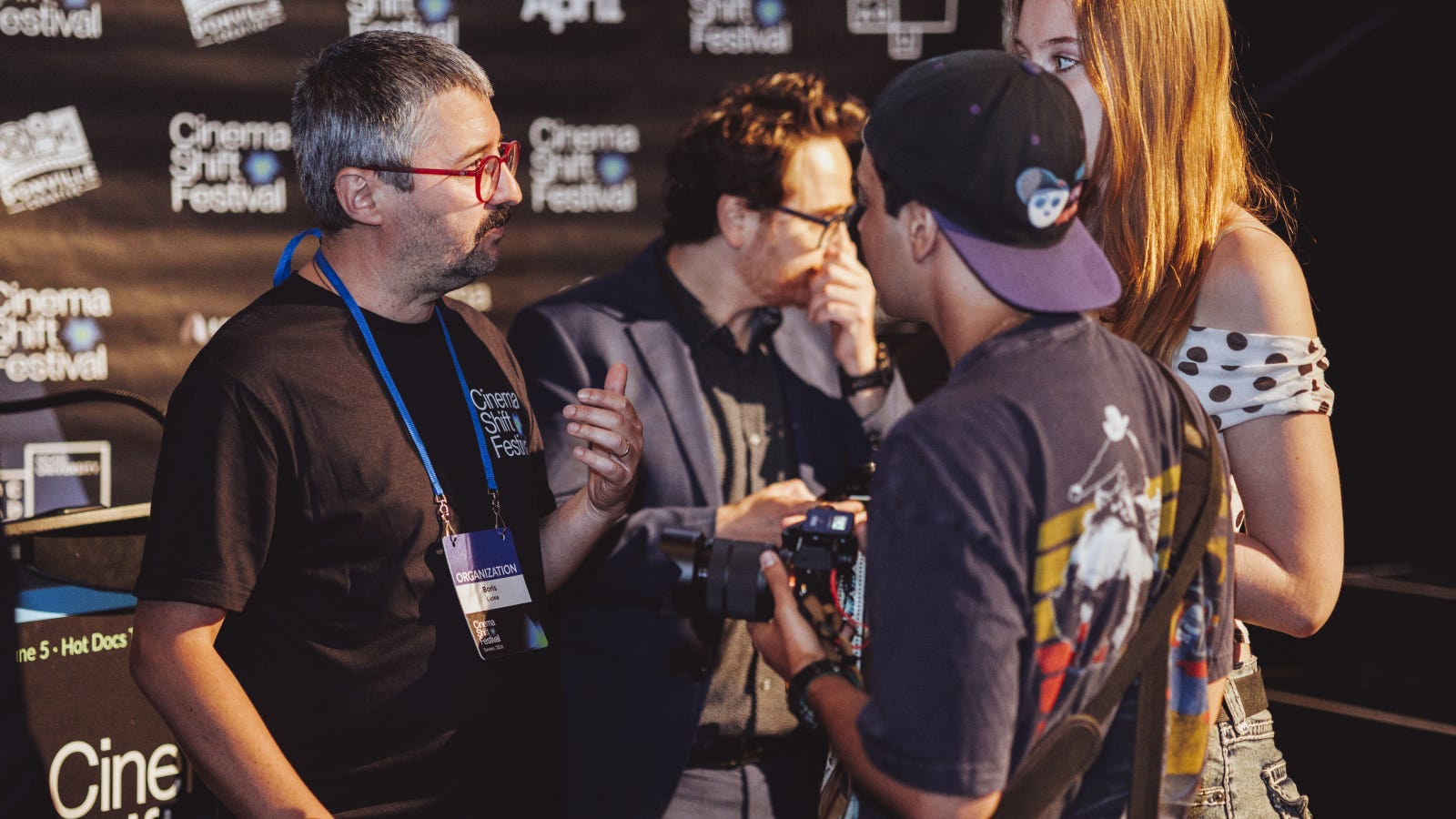
Boris Licina (left), jury member and curator, Cinema Shift Festival 2026. Photo by Kirsten Sonntag.
To decide when each movie would be screened was mostly my decision - all jury members agreed that Grandmère should go first, and Sinuca de Bico last. And I was playing with that order for days; it was the second best thing, after watching all the movies.
Before the first Cinema Shift Festival, while watching shorts at TIFF, I never thought about the order of the movies, as I just let it go and enjoyed. But now, it was I who had this exciting task - to make an emotional film journey that the audience would enjoy and remember. Grandmère is a gentle hybrid movie that combines old 8mm footage with AI-assisted footage, and story-wise it was perfect for opening - sort of to soften up the audience.
The most challenging one was The Legend, a 19-minute Canadian fantasy action film. I put that one in the middle, but strategically, I put When Is It Yours before it and Dial-A-Mate after The Legend. Before I made this decision, I moved them back and forth, trying to determine which emotion follows each film. Other than emotion, the type of movie was also important - I could not have 3 narrated movies one after another or two 10-minute shorts. Flow depended on film emotion, style, genre, and tone. But somehow, my focus was emotion, and I gave it priority.
What worked and what did not
Many of our submitters don’t even know how close they were to being in the program. I saw many movies that did not get in, and I found them exceptional. Why then did they not get in? Because I was choosing between two exceptional films, and if one was science fiction and I already had one, then it was less likely that this one would advance. What it means is - if you submit your film to the festival and you don’t get in, it certainly does not mean that your movie is not good.
Some were good, but had flaws that ultimately kept them out of the program. One of them was quite an interesting science fiction film that had a lip-sync problem. A character was opening their mouth, but the lines were late. It was just in this one scene, but that was enough. There was an amazingly good movie I really loved, but one of the characters resembled a living, very famous actor. I got angry as it was completely unnecessary; this character was not important, and the resemblance did not add any additional value - the movie was ruined. In another movie, the character literally said what was written in the prompt, something like “subtle head movement while speaking.” The same movie went on to win around 20 awards at various film festivals. We didn’t want to show slop or sloppiness on the big screen.
However, most of the films failed because of weak stories that resembled many others and used tropes we had already seen so many times - but not in an innovative way. And some of them were amazingly well done - in a technical sense - but without story and emotional impact, that’s not worth much. Some of the submissions had pacing problems - they felt too long even if they were just 3 minutes. Imitation was visible in some films, and AI made imitation very easy to do, but then authorship was gone.
Films that made it gave a clear sense of humans behind the wheel; we saw intention, strong stories and emotional impact. For many of them, you could say they were authentic and personal. These authors had an answer to the question: Why are you doing this movie right now, and why are you the right person to tell it?
This essay is part of my ongoing Cinema Shift notes on AI-assisted filmmaking, authorship, and the first wave of AI cinema.