

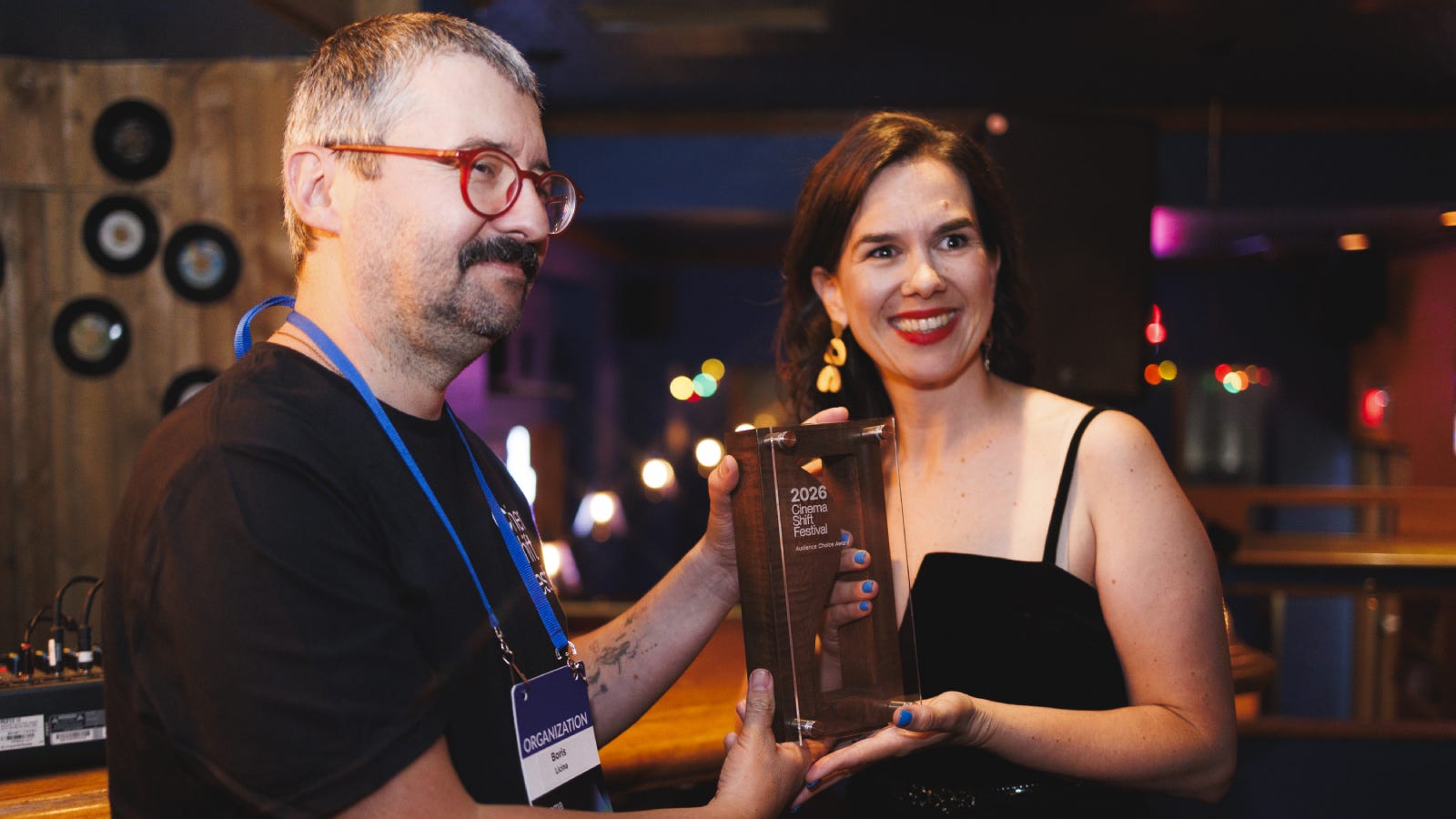
Ruza Vrdoljak Licina and Boris Licina, Cinema Shift Festival 2026 (Photo by Kirsten Sonntag)
I do not like AI film hype. That is probably the most polite way I can put it. I am especially allergic to posts claiming that if you are not using a particular AI tool, you are already behind. Or: “This scene would cost $2 million and take 100 days to make in Hollywood, but I made it in five seconds for free.”
I believe these hype posts are part of the reason people hate AI in filmmaking. They do nothing to start a conversation.
In 2025, the tech world was full of AI hype. Ruza, Cinema Shift’s Executive Director, who has a background in marketing and tech, saw it firsthand at Toronto tech events. At film events, I encountered skepticism and caution, to put it lightly. At York University, where I was a screenwriting student, professors rarely discussed AI in filmmaking; some seemed to prefer ignoring it, while others encouraged us to explore it with curiosity.
The tech and film worlds seemed to exist side by side without really speaking to each other.
By then, the Canadian entertainment industry was already actively discussing and experimenting with AI. From the outside, though, and this is just my personal observation, the public conversation still felt cautious and limited.
AI-assisted films began to appear on YouTube, and the one-click movie myth became widespread. The slop was already here, but so was some serious AI-assisted work.
We felt there was a need to curate the work and move the conversation away from “I made this in two minutes for free” towards a more serious discussion of AI-assisted films and the changing role of AI across film production.
December
We had been discussing the idea for months, but in December, six months before the festival, we finally decided to move forward.
“In the worst case, we’ll meet a lot of new interesting people,” we told each other.
Of course, the decision was also grounded in serious analysis. We knew that the change had arrived, and it was not the first major industry shift we had experienced.
In 2013, as social media and mobile phones were transforming the industry, Ruza and I started SoMo Borac - an annual digital marketing awards program for Southeast Europe. Today, it is a conference and regional awards program with more than 1,000 attendees.
Our combined experience gave us the confidence to organize the first Cinema Shift Festival in such a short period of time.
The Start
From the beginning, we approached AI-assisted films as cinema, treating AI as a tool rather than an author. We were curious about the stories people wanted to tell, and we wanted to curate everything carefully: the films, speakers, conversations, and mix of people we wanted to bring into the room.
I began watching even more AI-assisted films, almost obsessively, and read books such as Curating for Cinemas, Festivals, Archives. At the same time, I started writing the Cinema Shift Substack as our first point of contact with the audience. From the outside, it looked like a soft launch, but we were working day and night.
We also wanted to be taken seriously. One of our first calls was to screenwriter Fabio Montanari, my former professor at York University, whom we invited to join Cinema Shift as an advisor, curator, and jury member.
Fabio came from a traditional filmmaking background. We wanted the jury to evaluate AI-assisted films according to the same fundamental criteria used for any other film: storytelling, intention, craft, and emotional impact. The technology mattered, but it could not be the only reason a film was selected or awarded.
Samantha Wan and Ann Marie Fleming later joined the jury. Ann Marie was one of Ruza’s favourite Canadian filmmakers, and everyone seemed surprised that we had managed to involve someone like her in the festival’s first edition.
The explanation was simple: we sent her an email, explained what we were trying to do, and she was curious enough to say yes.
The Pushback
On April 9, Barry Hertz, Deputy Arts Editor and Film Editor for The Globe and Mail, wrote on X, formerly Twitter:
“Well this sounds … depressing: On June 5, Hot Docs will host “Canada’s First Curated AI Narrative Film Festival,” with prizes for films “with AI-generated or AI-directed visual, audio, or other elements comprising majority of final work,” and jury including Ann Marie Fleming (!).”
Even before Barry’s tweet, we had already encountered strong disagreement. Some people stopped talking to us, while others simply ghosted us when we told them what we wanted to do.
Just before the festival, a poster appeared on a utility pole near our building. It read: “If you make a flyer with AI generated ‘art’ we’re taking it down and throwing it away. Art should not poison people and kill children in other countries.” It was signed by Toronto AI Watch.
After Barry’s tweet, we contacted him and asked whether we could meet. He agreed, and we had a Zoom meeting.
It was a great conversation; we talked openly about AI in filmmaking, the good and the bad. Barry was insightful and intelligent, and the conversation helped me understand how skeptics of AI in filmmaking thought. We also agreed that some threats, such as job losses, were real.
In the end, we believe Barry’s tweet helped us.
The Momentum
His tweet gave us attention we might not otherwise have received. Some large companies reached out, looking for ways to partner with us. The filmmaking community noticed us as well.
Over those six months, we had countless calls and met people from across the emerging field. We spoke with organizers of AI film festivals around the world, AI-assisted and traditional filmmakers, and representatives of post-production and VFX companies.
For me, the most interesting part was speaking with people who had used AI tools to make their first film. There was so much excitement in finally being able to tell their stories.
In April, two months before the festival, we gave an interview to the Toronto Star, which was published online and in print. For us, this was a huge success because it allowed us to reach a much broader audience. Soon afterward, Playback, a leading Canadian trade publication for the film and television industry, covered the festival. It gave us visibility within Canada’s traditional film and television industry.
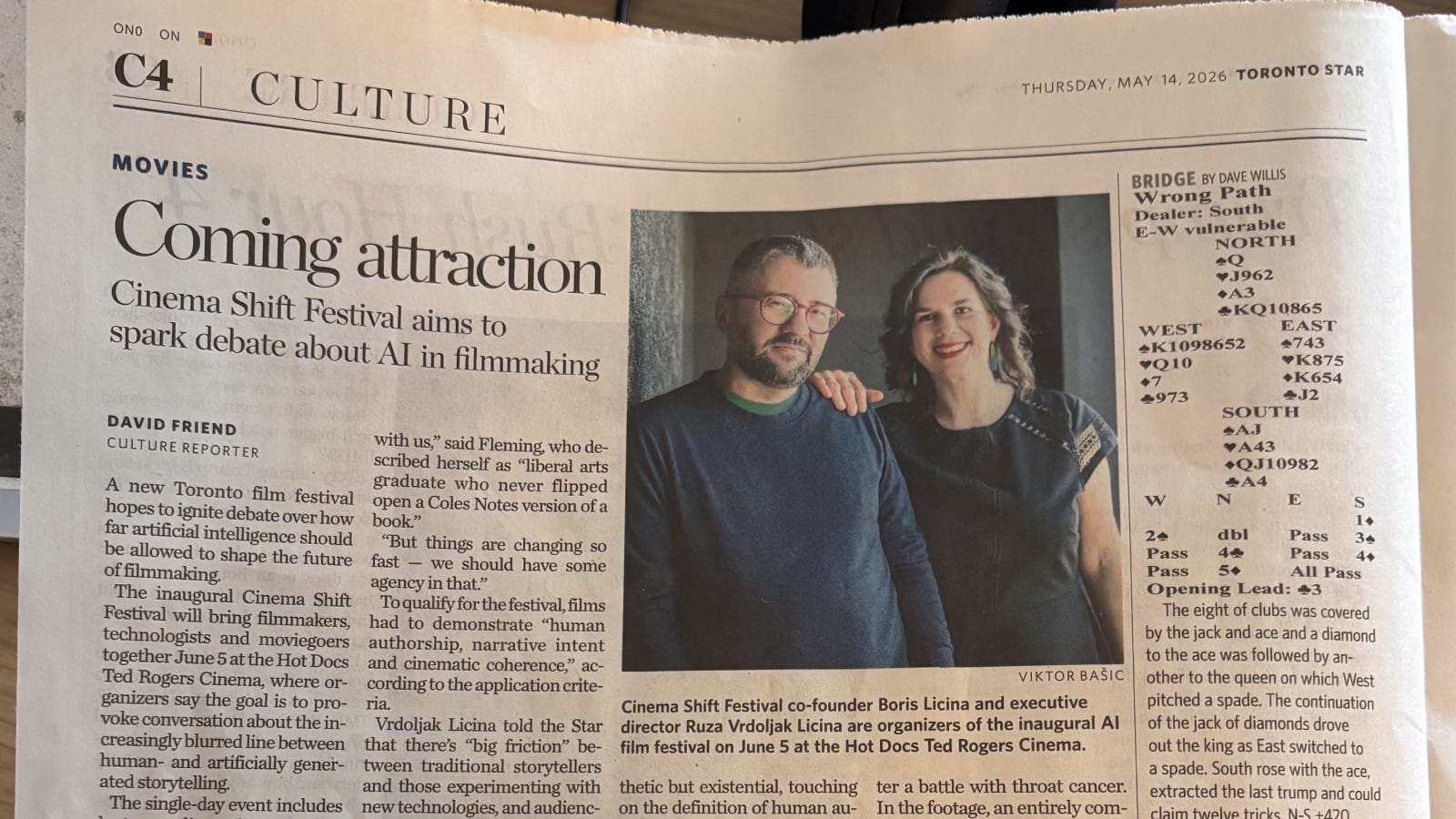
Cinema Shift Festival in Toronto Star
We also spoke with Toronto Today, which took a different angle. One of the independent filmmakers interviewed for the article said she was “affronted to learn the AI film festival was happening ‘on home turf’ in Toronto.”
That sentence saddened me because it seemed to imply that Toronto, despite being where we lived, was not our home turf. It was elitist and not inclusive at all, and a good way to close the conversation, the exact opposite of what we were trying to do.
On the day of the festival, we gave an interview to the CBC radio show Metro Morning, which has around 300,000 morning listeners. This felt like a personal victory because I have always struggled with stage fright and usually avoid situations like this.
But this time, I said yes. It was a new me - Canadian Boris, and the call was just too important to be missed.
The Fears
I had three practical fears: that we would not receive enough film submissions, that we would not secure enough sponsorship to cover our expenses, and that we would not sell enough tickets.
But these were problems I understood. We could build campaigns, contact partners, target filmmakers, and track ticket sales. The goals were measurable. The fourth fear was different. It was not a practical fear so much as the adrenaline of stepping into the unknown.
How do you define something that has not yet been defined?
With so many unanswered questions, I focused on what was important to me: story and authorship. My favourite part of the process was watching the submissions and taking notes. Through all that watching and note-taking, we began to define what the first wave of AI cinema was, or at least what we at Cinema Shift believed it should be.
My goal was for the audience to leave Hot Docs Cinema and talk about the stories, not the tools. But because we were in uncharted territory, surrounded by heated discussions and strong opinions, we knew we also wanted real conversations, not panels where everyone simply agreed with each other.
The opening conversation brought together Ann Marie Fleming and AI filmmaker Ryan Patterson. Zach Nickels from Dipchand LLP spoke about intellectual property in the age of AI, while Ryan Stasyshyn, head of Rodeo FX Toronto, discussed the use of AI in VFX and post-production.
Emmy-winning documentary filmmaker Katerina Cizek joined us for the closing conversation, bringing a strongly critical perspective on the corporations that own AI models. She also talked about constructive uses of AI and gave an example from the 2020 documentary Welcome to Chechnya. Director David France used AI face replacement to protect the identities of LGBTQ+ people fleeing persecution in Chechnya, while preserving their facial expressions and emotional presence in the documentary.
Success
On the morning of June 5, 2026, before the festival officially began, we knew we had succeeded.
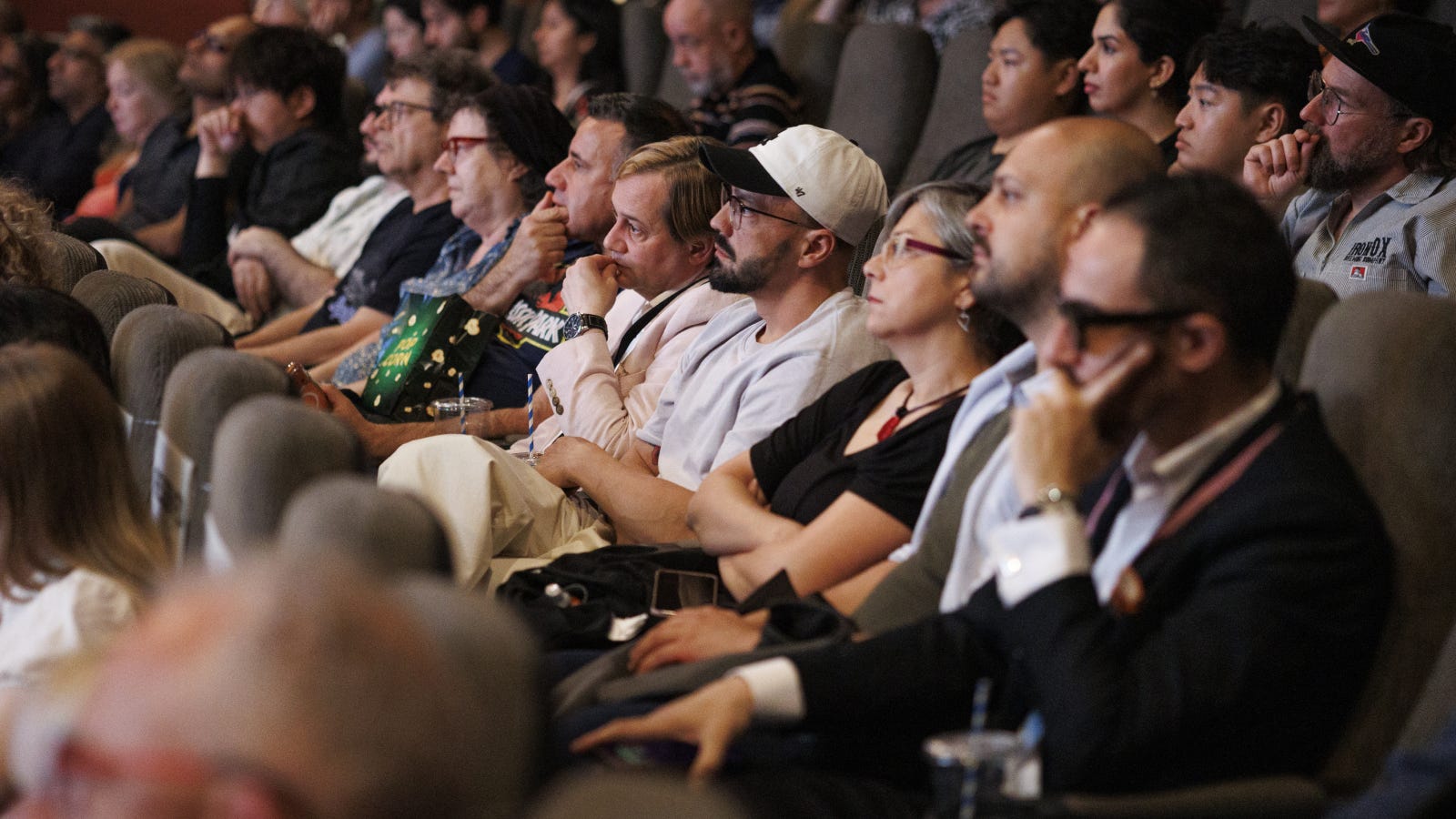
Cinema Shift Festival 2026 (Photo by Kirsten Sonntag)
Success came in phases. The first came when we finalized the screening order, and I felt confident in my creative decisions. The second came when we received the final funding confirmation we needed. The last arrived immediately before the festival began, when the final ticket was claimed. We had a full house.
And there was more: 38% of registered attendees were filmmakers, directors, or producers, while 53% came from film, AI and creative technology, or VFX and post-production. We had attracted the audience we wanted to bring together.
Ruza’s speech gave the opening a broader political and cultural dimension:
“For some of you, Canada is the country where you were born. For some of us, it is the country we chose. But for all of us in this room, it is a country whose future we care about deeply.
And if AI is going to shape that future, then this conversation cannot belong to only one industry, one discipline, or one point of view.
That is why Cinema Shift exists.”
Another moment that stayed with me was Ann Marie Fleming’s answer when she was asked whether she had been surprised by how deeply personal many of the AI-assisted films felt.
Her answer was simple: “No.”
Her point was that this is what filmmakers do: they tell personal stories. The tools do not change that.
At another point, she said:
“This is not an AI film festival. This is a film festival.”
The films took the audience on an emotional journey because we had programmed them to do so. Judging by the conversations that continued after the screenings and across the street, the program had connected with the audience.
In the end, our greatest success was not simply selling tickets or presenting awards. It was creating space for meaningful and serious conversations about both the possibilities and the problems of AI in filmmaking.
A couple of hours after we moved from Hot Docs Cinema to Paupers Pub across the street, we were still talking with filmmakers, academics, and enthusiasts about the films, the conversations, and what might come next.
Today, we are deep into preparation for 2027 and the second edition of the Cinema Shift Festival. Today, we are deep into preparation for 2027 and the second edition of the Cinema Shift Festival. Feel free to reach out if you want to be part of it - as a partner, speaker, or friend of the festival.
This essay is part of my ongoing Cinema Shift notes on AI-assisted filmmaking, authorship, and the first wave of AI cinema.
Every emerging medium eventually gets its own moral panic and submission deadline.