

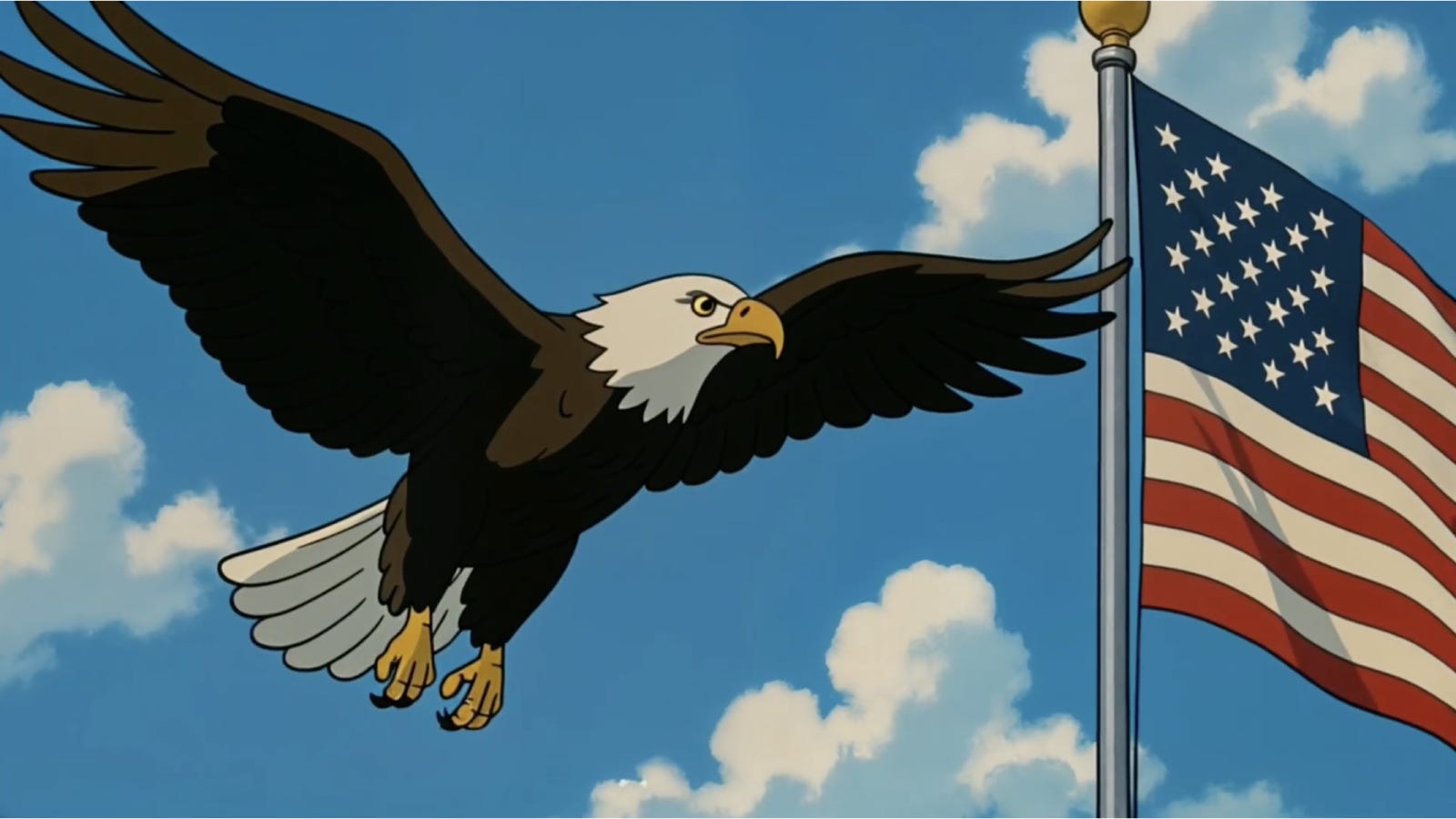
Photo: from the movie Zombie Monsters on Space Vacation
It’s late in the night; my kids and Toronto are sleeping. I am looking at two screens - on one is a video of an unknown person killing a proud eagle flying over an American flag and a giant sign that says SPACEPORT. I killed the eagle, and I do smile evilly and quietly. It is the beginning of my AI-assisted animated zombie horror comedy Zombie Monsters on Space Vacation. The film is an homage to the 80s parody movies; I grew up watching Top Secret, Spaceballs, Airplane, Naked Gun and others.
I wrote the script as a feature film during the summer between my 2nd and 3rd years at York University, where, as a mature student, I graduated in screenwriting. I entered it in a couple of screenwriting contests, and although I received good feedback, I never advanced to the finals.
On my screens, there are several tools open - Eleven Labs, Runway, Photopea and others - and my process is thorough. I am browsing through Pixabay’s free sounds library looking for the perfect zombie roar and the music that will play when zombies attack the dining hall in the first space hotel. Before that, I had around 50 images in front of me, thinking about which one was best for animation, and later which videos fit best with the music I had.
Every scene asks me to make several decisions or choose whether it fits at all; I need to put everything together in the video-editing software. It’s a slow process, which I will remember many times later on whenever I hear someone assume AI films are made with just a click of a button.
The one-click movie myth
THE MYTH / THE REALITY
Myth: AI films are made with one click.
Reality: the click creates material; the filmmaker still has to shape the film.
It took me around two months to finish it. In the end, I squeezed a feature film script into four short episodes around four minutes each. Squeezing a feature film script into a 15-minute movie is one of the most common things filmmakers do when making an AI-assisted movie. At least that’s what we saw in the first-year submissions for the Cinema Shift Festival 2026. And I am saying things - not a mistake - on purpose. Because at this time, I am not sure whether this is a new format or whether we examine AI-assisted movies through the lens of traditional films or a new one. We do live in the world of micro dramas, after all.
By making my own AI-assisted movie and watching hundreds of submissions and other AI films, I realized how wrong this misconception about a movie with a click of a button is. The number of decisions filmmakers working with AI tools make is huge and human. In the filmmaking process, AI is just a tool.
This was also the unofficial tagline of the Cinema Shift Festival - we repeated that daily in the meetings, interviews, and social media posts. And to make a good AI-assisted film, I realized that with my zombie comedy, you need to know the craft and the tools. AI tools helped me generate images and videos I could not create before, opening doors to filmmaking for me and many others. While barriers to making a movie have become lower, the knowledge to make a good movie remains the same.
What AI Gave Me - and What It Didn’t
Before I started making Zombie Monsters on Space Vacation as an AI-assisted web series, I was contemplating doing it as a podcast, but this was a better creative fit - as it had many visual gags that just would not work as an audio.
I did dialogues first. For that, I used the tool ElevenLabs, which provides AI voices. I went through many of them and chose a voice for all of my characters. Why did I use AI voices and not real actors? I did not have a budget for real actors. After that, I edited them in CapCut without any images or videos - just dialogues, as I wanted to know how it lands without any visuals. Do the jokes work? Is it clear what the scene is about? While ElevenLabs gave me voices, the dialogues and the pauses between sentences were mine, as well as all other sound design decisions.
AI tools generated images based on prompts I gave - as my movie was a homage to the 80s, I went with the 80s-style cartoon. In each scene, I made videos from images in Runway, which was also one of the helpful tools I used. And at the time - painful. At the time, for some videos, it felt like an endless prompting - suddenly there was a moustache man riding on a bicycle with one of the characters, which was an AI hallucination, as I never mentioned one.
I struggled with lip-syncing, so I kept it very basic and handled much of it manually, frame by frame. Definitely not perfect, but it worked.
Decisions, decisions
I love writing, and in the process of making a movie, that’s the part where I shine - not in a way that I am a brilliant writer but in personal fulfillment with the work. For this specific script, I’ve got feedback from some of my York University peers and my brother (who is a director and writer), and I did a couple of rewrites before the final one.
But most of the decisions were about what not to include, and realizing which dialogue and scenes do not work. When you have a script in front of you, sometimes it’s hard to see which scenes are not doing the job - like pushing the story forward or building the world in a new way. You, as a writer, are often in love with your script, and it’s hard to “kill your darlings.” By making my own movie, I saw firsthand how much I can lose from the script. I concluded that screenwriting schools should provide students with AI tools to make a short movie, specifically to give them experience in transferring the story from script to screen. That was one of my biggest and most unexpected learnings.
CASE FILE: The Dining Hall Attack
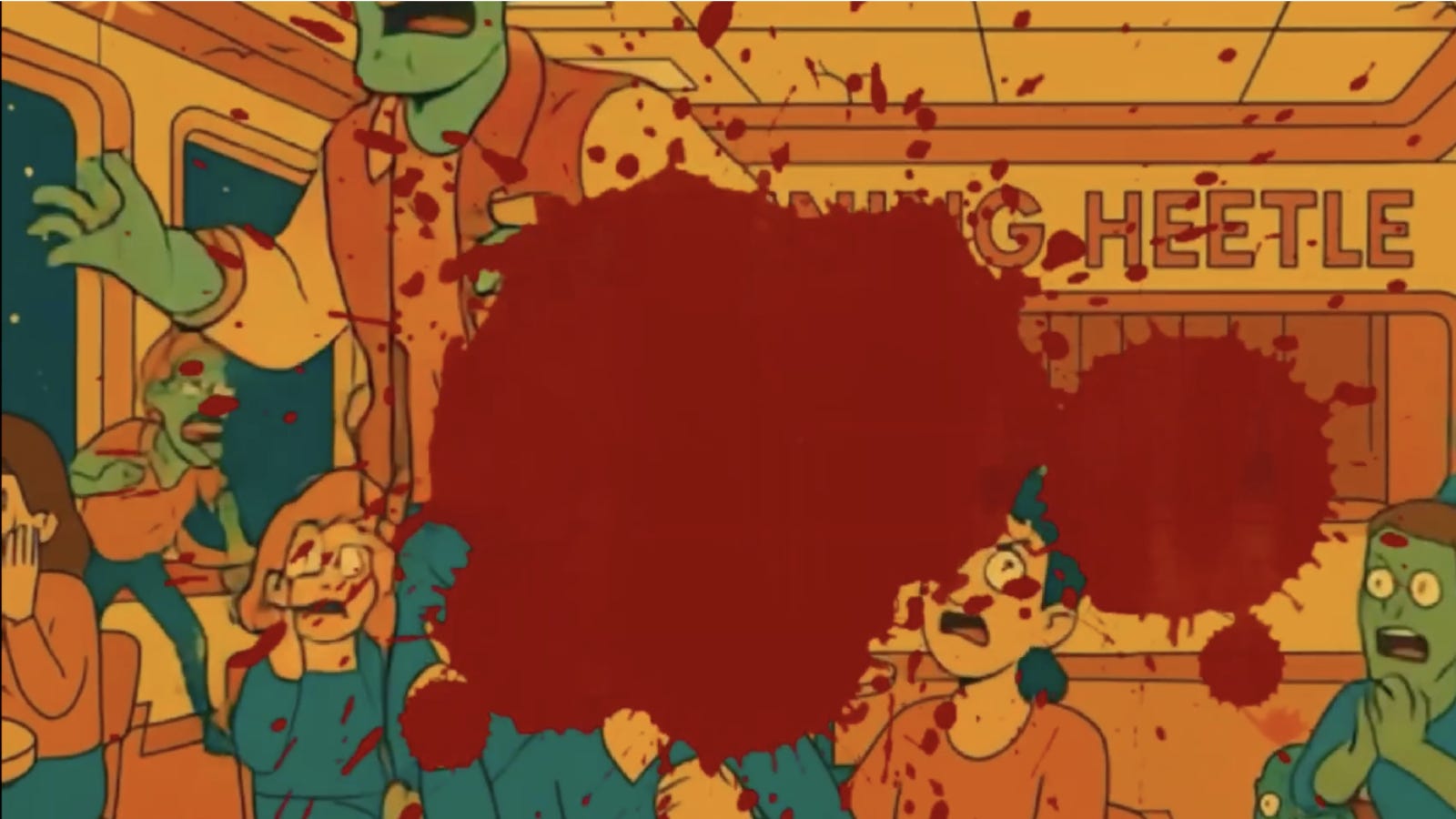
Photo: from the movie Zombie Monsters on Space Vacation
One of the most important scenes in my script was a zombie attack in the dining hall - it was a highly choreographed attack and fight. At the same time, my hero James is trying to fight zombies and turn off the TV with him on it - and an embarrassing scene he does not want anyone to see, especially Amy (his love interest).
In the AI-assisted movie I made, that scene lasted 7 seconds. It was nearly impossible to do a full scene from the script. The tools were not there, and I was not there even if the tools were. I believe that even today it’s hard to do it.
What was left from this complex scene were zombies entering the dining hall, blood splashing on the camera, and our main characters running away through the hall. Working on this script-to-screen scene taught me that in AI-assisted film, I should keep it simple. I believe this learning is the same for all independent films, where budget does not allow complex choreography and shots. What I did not do, and should have, was tell James’ story in this scene in a less complicated way without losing the funny part. These seven seconds did not do that - If I were writing it again today, the scene would be different for sure, especially for AI-assisted film.
The story is human
When we were preparing the Cinema Shift Festival, we talked with many people from the film industry, and I was surprised by two things: a lack of curiosity and a lack of understanding of how complex it is to make an AI-assisted film. After those calls, we were even more decisive in our belief that the festival is a great idea, to show what it’s all about and to talk about both the good and the bad. Our mantra was that AI is a tool, and we said it so many times to show that human authorship remains strong in the decisions filmmakers make and the stories they tell. The question we asked at our festival was: What does authorship mean in the age of AI filmmaking?
For me, and that was the main idea of the Cinema Shift Festival, the core was always the story - and this is what stays. Whenever the story is human, the author is human. I for sure see Zombie Monsters on Space Vacation as my film - not only because the story was mine, but because of all the creative decisions I made. And the movie was not the best, but it showed me that authorship did not disappear. With AI, I’ve got access, but craft I still need to learn.
This essay is part of my ongoing Cinema Shift notes on AI-assisted filmmaking, authorship, and the first wave of AI cinema.